
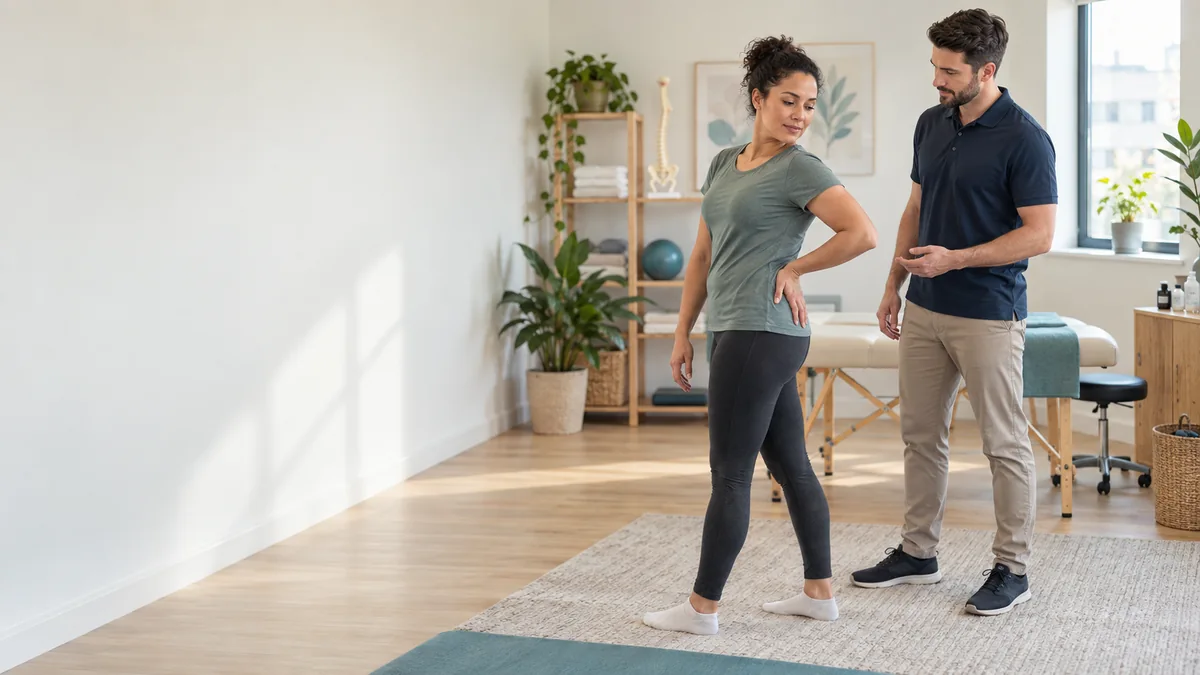
You stand up after a long morning at your desk and take a few stiff steps. Your hips feel reluctant to straighten, your lower back aches, and moving around gradually makes everything feel easier. By the end of another busy week, the same pattern has returned.
Experiences like this are familiar to many people with lower back pain. They can involve muscle tension, reduced movement and a mismatch between what the body regularly does and what we ask it to do. Understanding these connections can help us choose a more useful approach than repeatedly treating the sore spot alone.
However, persistent back pain rarely has one simple explanation. Stiff muscles can contribute to discomfort, but pain itself can also make muscles tighten and movement feel restricted. The aim is to restore comfortable movement and build confidence and capacity, without assuming your back is damaged or fragile.
What do we mean by muscle stiffness?
“Muscle compliance” describes how readily a muscle yields when a force stretches it. For everyday conversation, stiffness and reduced ease of movement are more helpful words.
You might notice difficulty bending towards your shoes, tightness across your waist or a pulling sensation through your buttocks and thighs. These sensations are real, but they do not tell us exactly what is happening inside a muscle.
Feeling tight can reflect protective muscle activity, sensitivity or reduced familiarity with a movement, as well as changes in tissue flexibility. Research by Stanton and colleagues suggests that perceived back stiffness can involve a protective response and does not necessarily reflect measurable mechanical stiffness. This is one reason assessment should explore how you move and feel, rather than assuming every tight area needs forceful stretching. Stanton et al., 2017.
Your lower back connects your upper body and legs
The lower back sits between the ribcage and pelvis. Together with the hips, it helps transfer forces when you walk, lift a shopping bag, climb stairs or get out of a chair.
Several structures share this work. The back muscles help control the spine; the abdominal muscles help manage trunk movement and pressure; and the gluteal muscles help control the hips and pelvis.
A broad sheet of connective tissue called the thoracolumbar fascia forms part of this network. It has connections with back and abdominal muscles, the pelvis, the gluteus maximus and the latissimus dorsi, a large muscle extending towards the upper back and arm. These connections help explain how forces can be shared between the trunk and limbs. They do not mean that tension in one location inevitably causes pain elsewhere. Willard et al., 2012.
The abdominal wall also helps contain the abdominal organs. Alongside the diaphragm and pelvic floor, it contributes to pressure control during breathing and effort. This is a coordinated system: supporting the trunk does not require constantly pulling your stomach in or keeping your back rigid.
A capable back needs strength and endurance, but also the freedom to bend, rotate and relax.
What happens when much of the day is spent sitting?
Sitting is a normal activity. The difficulty for some people is spending long periods in one position with very little movement between them.
At a desk, the hips and knees remain bent, and the legs do less of the repeated muscular work involved in walking. Some people gradually become uncomfortable in that position. If the working day is followed by a seated commute and an evening on the sofa, there may also be fewer opportunities to maintain strength and movement variety.
Over time, a less active routine can leave everyday demands feeling harder. A long walk or afternoon of gardening may ask more of your muscles than they are accustomed to providing.
However, research does not support a simple claim that sitting inevitably causes lower back pain. A systematic review of longitudinal studies found no association between sedentary time and the development of back pain across the duration categories examined, although some evidence linked sedentary behaviour with disability in people with back pain. Alzahrani et al., 2022.
The practical message is to introduce comfortable movement throughout the day. Changing position, taking a short walk or standing for a phone call may be more useful than trying to maintain one “perfect” posture.
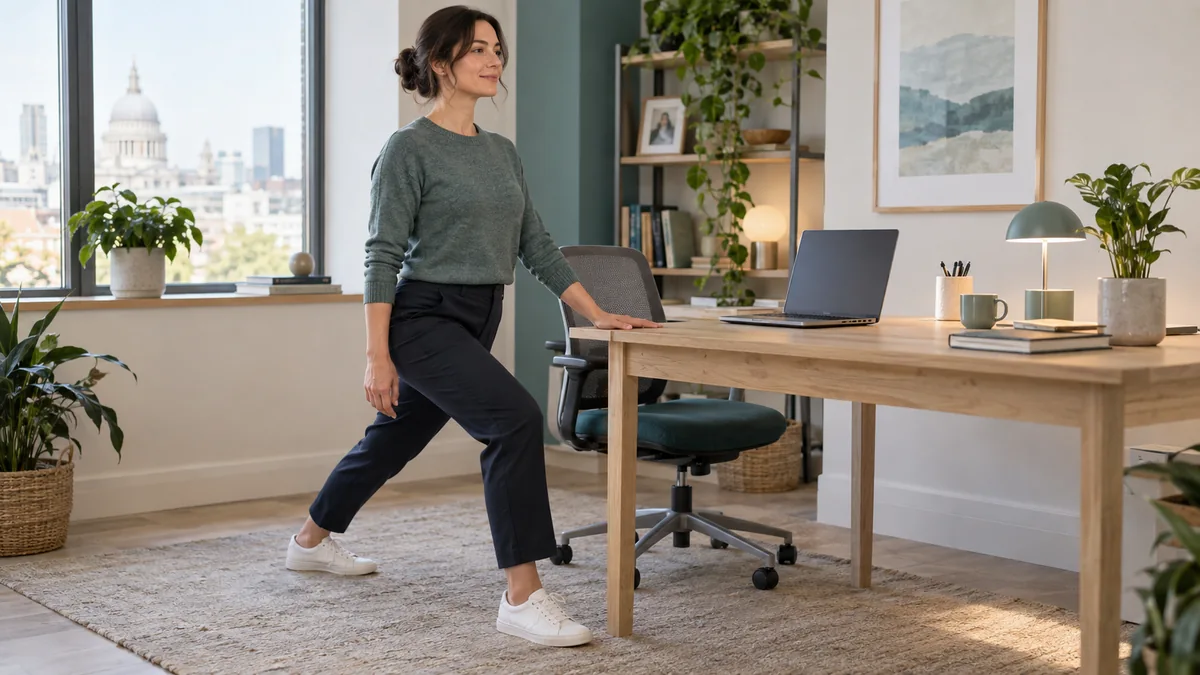
Movement also supports circulation
When the leg muscles contract, they assist the movement of blood back towards the heart. Movement also supports lymph transport, helping return excess tissue fluid to the circulation.
Sitting still reduces the contribution from these repeated muscular contractions. However, the lymphatic system continues working: lymphatic vessels have their own pumping activity, and breathing and surrounding tissue movements also contribute. Scallan et al., 2016.
Movement breaks therefore make sense for general comfort and circulation. But it would be misleading to describe ordinary desk work as causing lymphatic failure, or to suggest that poor lymph flow is an established explanation for chronic muscular back pain.
How the hips and thighs influence the back
The gluteal muscles help straighten the hips and control the pelvis during walking, climbing and lifting. The muscles towards the side of the buttocks are particularly useful when you support your weight on one leg.
If their strength or endurance is limited, certain activities may become harder, and you may use different movement strategies to complete them. This can change the demands on the lower back. It is a possible contributor to symptoms, rather than proof that weak glutes caused them.
Sitting does not switch these muscles off permanently. They may simply receive too little challenging activity to maintain the capacity you need. They can also feel tense or tender while having limited endurance: tightness and strength are different qualities.
The hamstrings at the back of the thighs connect the pelvis to the lower leg, with the exception of the short head of biceps femoris, which starts on the thigh bone. They assist hip extension and knee bending. Limited comfortable hamstring movement can influence how the pelvis and spine move when you bend forwards.
It is too simplistic to say sitting automatically shortens the hamstrings. Bending the hip lengthens them at one end, while bending the knee shortens them at the other. Their response depends on the position and the individual.
Similarly, the quadriceps are four muscles at the front of the thigh, but only one, rectus femoris, crosses the hip as well as the knee. They are not all shortened by sitting. The hip flexors are more directly associated with the bent-hip position, although holding that position does not prove permanent shortening.
These distinctions matter because treatment should address an actual movement difficulty, rather than an assumed chain of shortened muscles.
How discomfort can become a recurring cycle
Imagine that your back feels uncomfortable after work. You begin avoiding bending and exercise because you worry about making it worse. You move less, everyday tasks feel more demanding, and your muscles tense in anticipation of discomfort.
This is one possible cycle, rather than a diagnosis. Pain lasting longer than three months is usually described as chronic or persistent. At that stage, sleep, stress, previous experiences and sensitivity within the pain system may matter alongside physical capacity. The World Health Organization recommends care that considers these interacting influences and the person's circumstances. WHO, 2023.
Recovery can involve gradually showing your body that movement is manageable again. Someone who feels stiff may need a combination of reassurance, symptom relief and strengthening, rather than stretching alone.
Where massage and stretching can help
Soft tissue massage may help ease discomfort and the feeling of tension, making movement more comfortable. Depending on your symptoms and preferences, treatment may include the lower back, glutes and thighs. Abdominal treatment requires a specific reason, appropriate screening and your consent; it is not necessary for everyone with back pain.
A Cochrane review found possible benefits from massage, particularly short-term improvements compared with inactive controls, but rated the evidence low or very low quality. Massage should therefore be presented as an option for symptom relief, without promising to correct the underlying cause or permanently change tissue structure. Furlan et al., 2015.
Gentle stretching can also be useful when a particular movement feels restricted. It should suit your response, rather than involve forcing through pain. People who already have generous joint movement may benefit more from control and strength than additional flexibility.
When treatment helps you feel more comfortable, that can be an opportunity to return gradually to walking, exercise and everyday activities.

Building strength for everyday life
Exercise is a central part of managing persistent lower back pain. A Cochrane review covering 249 trials found moderate-certainty evidence that exercise probably improves pain compared with no treatment, usual care or placebo. Average improvements in disability were smaller. This supports a gradual exercise programme, without promising that one movement will work for everyone. Hayden et al., 2021.
The following are examples of movements a suitably qualified professional might adapt for you. They are not a programme to complete regardless of your symptoms.
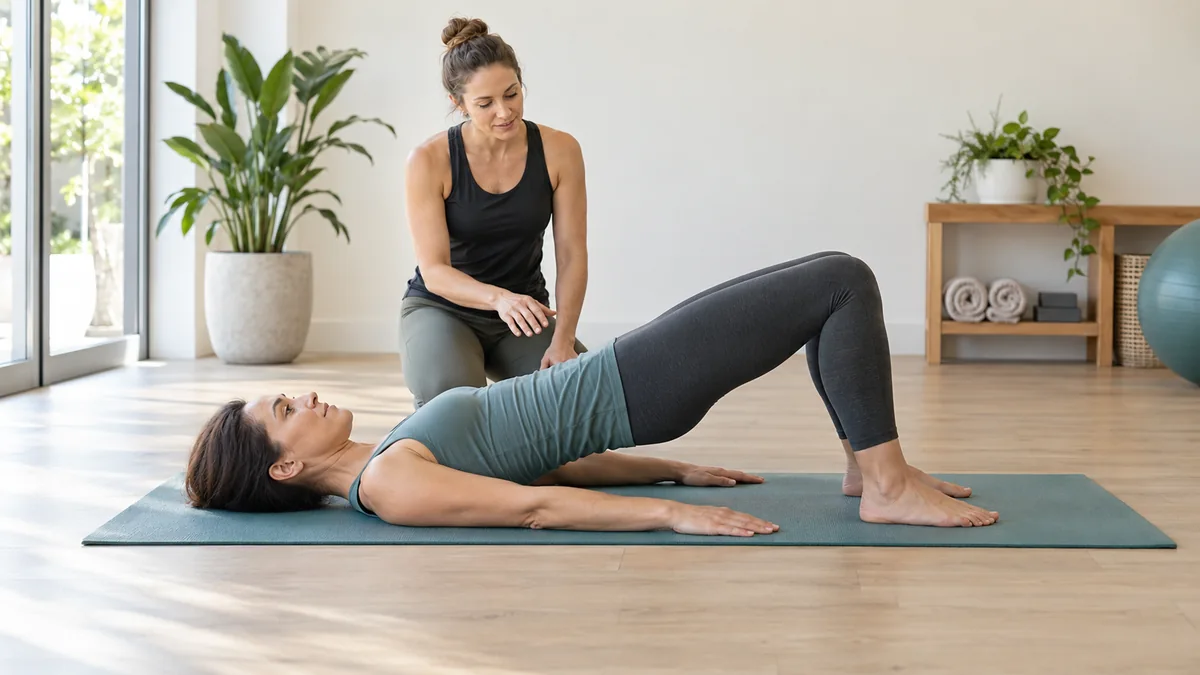
Bridge
Lying on your back with knees bent and feet supported, you lift the pelvis through a manageable range. This challenges the glutes and other muscles involved in hip extension while practising trunk and pelvic control. A smaller lift may be a useful starting point; lifting higher is not automatically better.
Plank
Supporting yourself against a wall, bench or floor challenges the trunk muscles to maintain a position while you breathe. Wall or raised-surface versions allow the effort to be adjusted. The aim is manageable control, rather than the longest possible hold.
Squat
Bending through the hips and knees and returning to standing develops leg and hip strength for tasks such as getting out of a chair. A supported sit-to-stand can be an accessible starting version. Depth and resistance can increase as confidence and capacity improve.
Lunge
Lowering and rising in a split stance challenges the legs, hips and balance. It can help develop control when the legs work in different positions. Hand support, a shallow range or a stationary split squat can make it easier to begin.
Exercise choice, resistance and progression should reflect your health, goals and response. Stop and seek advice if an exercise clearly worsens symptoms, causes spreading pain, numbness or weakness, or leaves a substantial flare-up that does not settle.
An approach built around you
At Massage Practice, we consider your symptoms alongside your working routine, activity and goals. Where appropriate, we can work with the personal trainers and Pilates instructors we cooperate with to support an individual plan. With your permission, sharing relevant information can help connect treatment with exercise advice.
Some people need help returning to activity after a painful episode. Others need more strength, less prolonged sitting or a manageable way to exercise consistently. Persistent or unexplained symptoms may require assessment by a GP or musculoskeletal clinician before progressing.
Seek emergency assessment for back pain with new bladder or bowel changes, numbness around the genitals or anus, or symptoms affecting both legs. Fever or feeling unwell with back pain, rapidly worsening pain, unexplained weight loss or persistent night pain also warrant medical advice, with urgency depending on the symptoms. NHS back pain guidance.
If recurring stiffness is affecting your working day, an appointment can help explore whether massage is suitable and what further support you may need. The goal is to help you move more comfortably and build the capacity for the things you want to do.
Research & references
- Willard FH, Vleeming A, Schuenke MD, Danneels L, Schleip R. The thoracolumbar fascia: anatomy, function and clinical considerations. Journal of Anatomy. 2012;221(6):507–536. Read the anatomical review.
- Alzahrani H et al. The association between sedentary behavior and low back pain in adults: a systematic review and meta-analysis of longitudinal studies. PeerJ. 2022;10:e13127. Read the systematic review.
- Furlan AD, Giraldo M, Baskwill A, Irvin E, Imamura M. Massage for low-back pain. Cochrane Database of Systematic Reviews. 2015;9:CD001929. Read the systematic review.
- Hayden JA, Ellis J, Ogilvie R, Malmivaara A, van Tulder MW. Exercise therapy for chronic low back pain. Cochrane Database of Systematic Reviews. 2021;9:CD009790. Read the systematic review.
Additional research: Stanton et al. on perceived stiffness, 2017; Scallan et al. on lymphatic pumping, 2016. Clinical guidance: WHO chronic lower back pain guidance, 2023; NHS back pain guidance.
General information, not a diagnosis or individual exercise prescription. Images are AI-generated editorial illustrations, not photographs of our premises, therapists or clients.