

On this page
Understanding your movement
What does joint hypermobility mean?
Joint hypermobility means that one or more joints move further than expected for a person’s age and background. It can reflect the natural stretchiness of the connective tissues that help support a joint. Many people are naturally flexible and have no pain or difficulty at all. Hypermobility is a description, not automatically a disorder.
When extra movement comes with persistent pain, repeated sprains or a feeling that a joint may give way, a clinician may consider a hypermobility spectrum disorder (HSD) or another explanation. Hypermobile Ehlers–Danlos syndrome (hEDS) is a separate clinical diagnosis with additional requirements. Neither condition is diagnosed simply by being “double-jointed” or achieving a particular score.
The important question is not just “How far can this joint move?” It is also “How comfortably and confidently can you use it?”
A useful starting point
What is the Beighton score?
The Beighton score is a nine-point movement screen. It samples a small selection of joints and movements; it does not measure every joint or how much pain someone experiences.
| Movement assessed | Points |
|---|---|
| Little finger bends backwards beyond 90° | 1 each side · 2 maximum |
| Thumb reaches the forearm | 1 each side · 2 maximum |
| Elbow extends beyond straight by more than 10° | 1 each side · 2 maximum |
| Knee extends beyond straight by more than 10° | 1 each side · 2 maximum |
| Both palms rest flat on the floor with knees straight | 1 point total |
| Maximum score | 9 points |
This explains what is assessed, not an invitation to force a self-test. Do not push a joint into pain or repeatedly demonstrate its end range.
Interpretation depends on age, history and the clinical framework being used. Shoulders, hips and ankles are not directly scored, and flexibility may change with age, injury or surgery. A low score does not necessarily rule out clinically important hypermobility. A review highlighted these limitations and recommended using clinical judgement alongside the score (Malek et al., 2021).
Beighton, not Brighton
The nine-point screen is called the Beighton score. The older Brighton criteria combined a Beighton score with a broader history of symptoms. The names refer to different things.
Why can flexible joints feel tight or painful?
Joint flexibility and muscle tension are not opposites. A joint can have plenty of available movement while the surrounding muscles feel tired, guarded or stiff.
One possible explanation is that muscles work harder to guide and steady a joint when its passive supports offer less resistance. That effort may become noticeable during long periods of standing, desk work or repeated exercise. Feeling tight does not always mean a muscle needs to be made longer.
Around the knee
Repeatedly resting in a locked-back position may be uncomfortable for some people. The thigh, calf and hip muscles all contribute to controlling load, so assessment should look beyond the painful spot.
Around the lower back
Some people habitually rest at the end of their available back movement. Changing position and building comfortable movement control may be more useful than continually stretching further.
These are possible contributing patterns, not proof that hypermobility caused the pain. Injury, training changes and other conditions still need consideration. For more on back discomfort, read our guide to lower back pain and muscle stiffness.
The whole picture
What should a hypermobility assessment involve?
A good assessment goes beyond a number. It connects your symptoms with the movements and activities you want to do. Depending on the clinician and your concerns, it may include:
- Your story. When symptoms began, previous sprains or dislocations, past flexibility, family history and what makes daily life difficult.
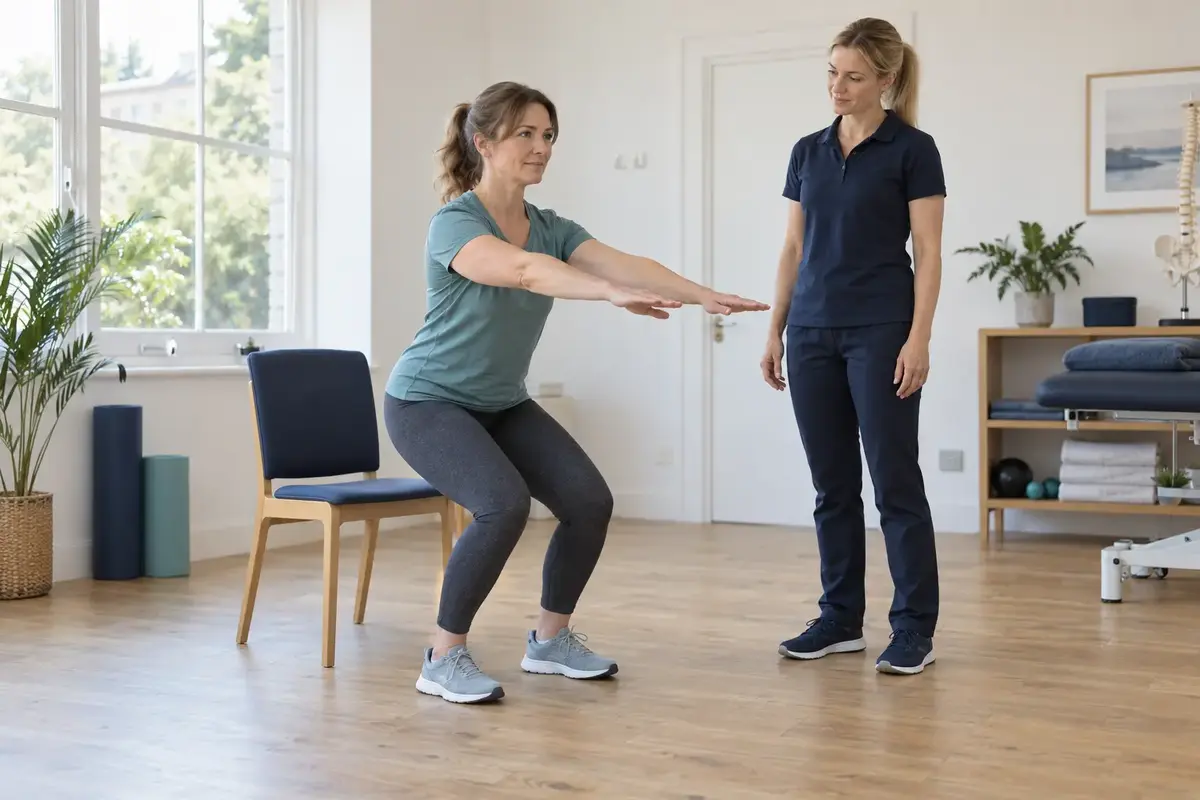
- Comfortable movement. Relevant joint range, muscle strength, balance and how you manage ordinary tasks, such as rising from a chair.
- A plan and the right support. Agreeing useful goals and deciding whether a GP, physiotherapist or other suitably qualified clinician should investigate further.
A massage appointment can explore muscular discomfort and treatment suitability, but it is not a substitute for medical assessment of a suspected connective-tissue disorder.
What may help: strength, control and pacing
For symptomatic hypermobility, care usually focuses on making movement more manageable. That often means gradual strengthening, balance work and improving awareness of joint position, sometimes called proprioception. A clinician can help select a starting point that matches your symptoms and health.
In a systematic review, all 11 included studies used exercise as a core part of treatment. Participants often improved, but evidence that the programmes outperformed comparison treatments was weak; studies were frequently small and long-term follow-up was limited (Palmer et al., 2021). This supports a tailored approach, not a promise that one routine works for everyone.
Start within capacity
Choose a manageable amount of activity, then progress gradually.
Practise control
Aim for comfortable, steady movement rather than the greatest range.
Build in variety
Change position and pace demanding tasks instead of pushing through a flare.
The NHS guidance on joint hypermobility also emphasises strength and fitness, and advises against overextending joints simply because you can.
Where do massage and stretching fit?
Soft-tissue work may help some people feel more comfortable by easing the sensation of muscular tension. Pressure, positioning and session length should be adapted to your response, especially if you bruise easily or have sensitive tissues.
A systematic review found short-term benefits from massage for pain or function in some common musculoskeletal conditions, compared with no treatment. It found no clear advantage over other active treatments. Crucially, it was not a review of massage for hypermobility, so its findings cannot establish a specific benefit for HSD or hEDS (Bervoets et al., 2015).
Comfort is a useful goal. Changing ligament laxity is not.
Massage cannot tighten lax ligaments or treat the underlying connective-tissue difference. Think of it as optional support alongside active management, not the main solution.
Stretching is not automatically forbidden, but more range is not always what you need. A genuinely restricted muscle may benefit from a gentle, targeted stretch with the joint supported. Avoid forceful end-range stretching of an already very mobile joint. If stretching only brings brief relief before tightness returns, ask whether strength, load or movement control needs attention instead.
Our remedial massage, knee-pain and lower-back-pain pages explain the scope of hands-on care at the practice.
Common questions
Does a high Beighton score mean I have Ehlers–Danlos syndrome?
No. It records selected movements, not a diagnosis. Symptoms, personal and family history, other clinical features and alternative explanations need assessment.
Can I be hypermobile even with a low score?
Yes. The score does not directly test every joint, and past injury or reduced flexibility can influence the result. Explain both present symptoms and previous flexibility to your clinician.
Should I stop exercising if my joints are hypermobile?
Hypermobility alone is not a reason to stop. The aim is an appropriate level of activity with gradual progression. Persistent pain, recurrent instability or repeated flares are reasons to seek individual guidance.
When should I seek medical advice?
Speak to a GP if you suspect a hypermobility disorder, particularly with persistent joint pain, recurrent dislocations or symptoms beyond the joints. A new suspected dislocation, severe pain after injury or a hot swollen joint needs prompt medical assessment, not massage.
The takeaway
More movement is not always the goal.
More comfortable movement is.
The Beighton score is a starting point. Your symptoms, strength and confidence matter too. A useful plan supports what you want to do, builds capacity gradually and uses hands-on care only where it helps.
References
- Malek, S., Reinhold, E.J. and Pearce, G.S. (2021). The Beighton Score as a measure of generalised joint hypermobility. Rheumatology International, 41, 1707–1716. Narrative review. doi:10.1007/s00296-021-04832-4.
- Palmer, S., Davey, I., Oliver, L., Preece, A., Sowerby, L. and House, S. (2021). The effectiveness of conservative interventions for the management of syndromic hypermobility: a systematic literature review. Clinical Rheumatology, 40, 1113–1129. doi:10.1007/s10067-020-05284-0.
- Bervoets, D.C., Luijsterburg, P.A.J., Alessie, J.J.N., Buijs, M.J. and Verhagen, A.P. (2015). Massage therapy has short-term benefits for people with common musculoskeletal disorders compared to no treatment: a systematic review. Journal of Physiotherapy, 61(3), 106–116. doi:10.1016/j.jphys.2015.05.018.
General educational information, not a diagnosis or individual treatment prescription. The photographs are AI-created illustrative scenes; they do not show actual patients or members of our team.